
Views: 0 Author: Lucas.lu Publish Time: 2026-08-07 Origin: Site


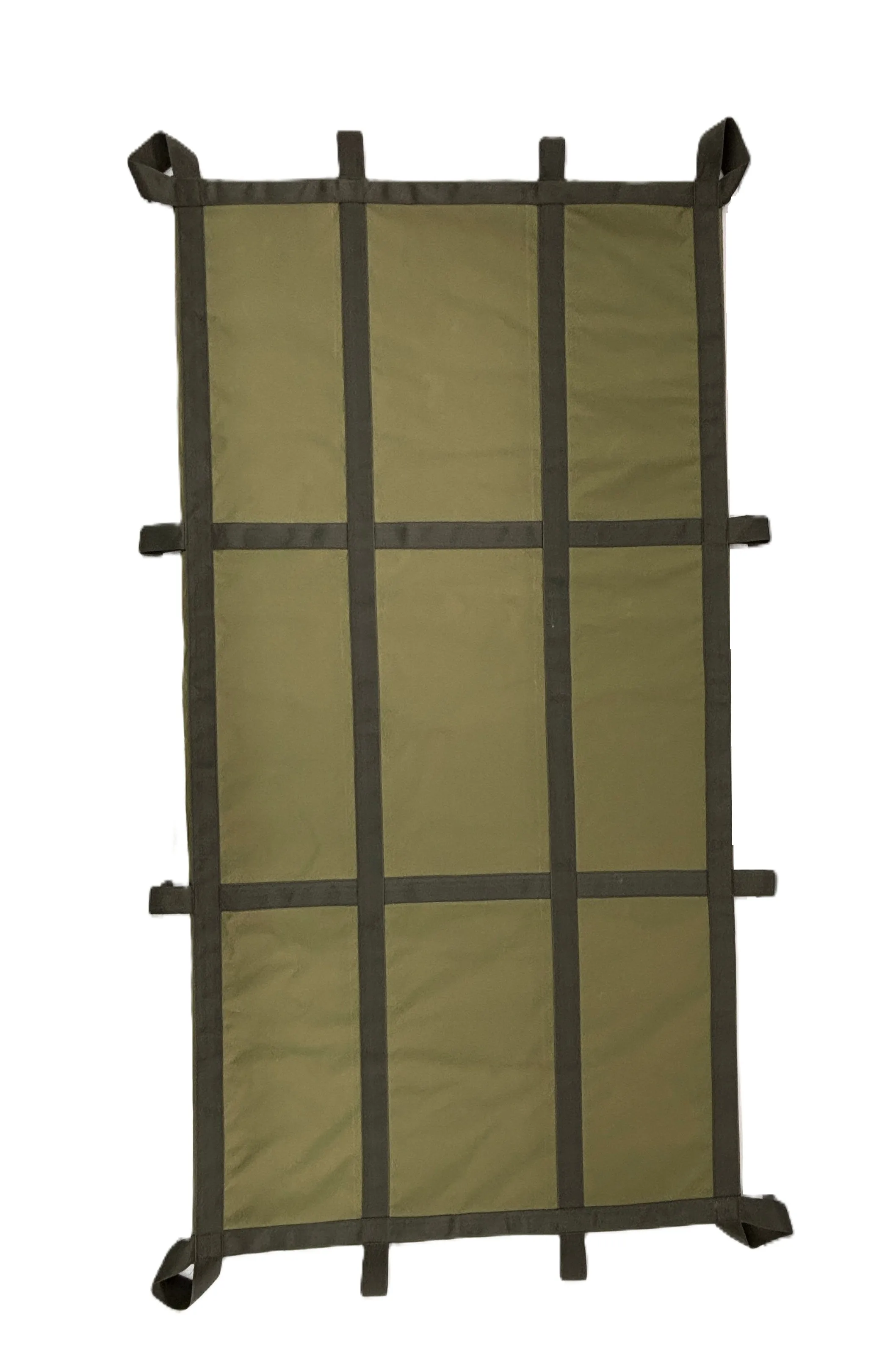
Real photo of explosion-proof blanket
Quick answer: A bomb blanket's real protection is proven by its V50 ballistic limit — the velocity at which a fragment has a 50% chance of penetration. In an independent test to GA/T 950-2019 using a 1.1 g fragment-simulating projectile (FSP) at 5 m, an Ultra Safety soft ballistic panel (947 g, 400 × 400 mm) achieved a V50 of 654 m/s. For procurement teams, that single number is the most objective way to compare bomb blankets before you buy.
If you source explosive-ordnance-disposal (EOD) or anti-terror equipment, this guide explains how to read a V50 report, what the numbers mean, and which specifications to demand from any supplier.
A bomb blanket (also called a ballistic blanket or blast suppression blanket) is a flexible, multi-layer aramid/UHMWPE panel designed to contain fragments and mitigate blast from a small improvised explosive device (IED) or suspicious package. Unlike rigid armor plates, it drapes over a threat and is carried by integrated handles.
Typical B2B buyers and use cases:
EOD / bomb disposal units — covering a suspect device to reduce fragment spread
Police & anti-terror teams — rapid containment of suspicious luggage or parcels
Military & VIP security — improvised cover during transport or evacuation
Critical infrastructure & aviation security — screening areas, mail rooms, checkpoints
Because these are life-safety products, third-party test data — not marketing claims — should drive the purchase.
V50 is the velocity at which a specified projectile has exactly a 50% probability of perforating the armor. It is the international benchmark for fragment protection because it turns "does it stop bullets?" into a measurable, repeatable number.
Higher V50 = higher protective capability against fragments at that mass.
V50 is tested with fragment-simulating projectiles (FSPs), which replicate the steel fragments thrown by an exploding IED — the primary killer in a blast, far more than the blast wave itself.
It is calculated by averaging the highest partial-penetration velocities and the lowest complete-penetration velocities within a set velocity spread.
This is why a credible bomb blanket spec sheet always leads with standard + projectile mass + V50 value. Missing any of the three makes the number meaningless.
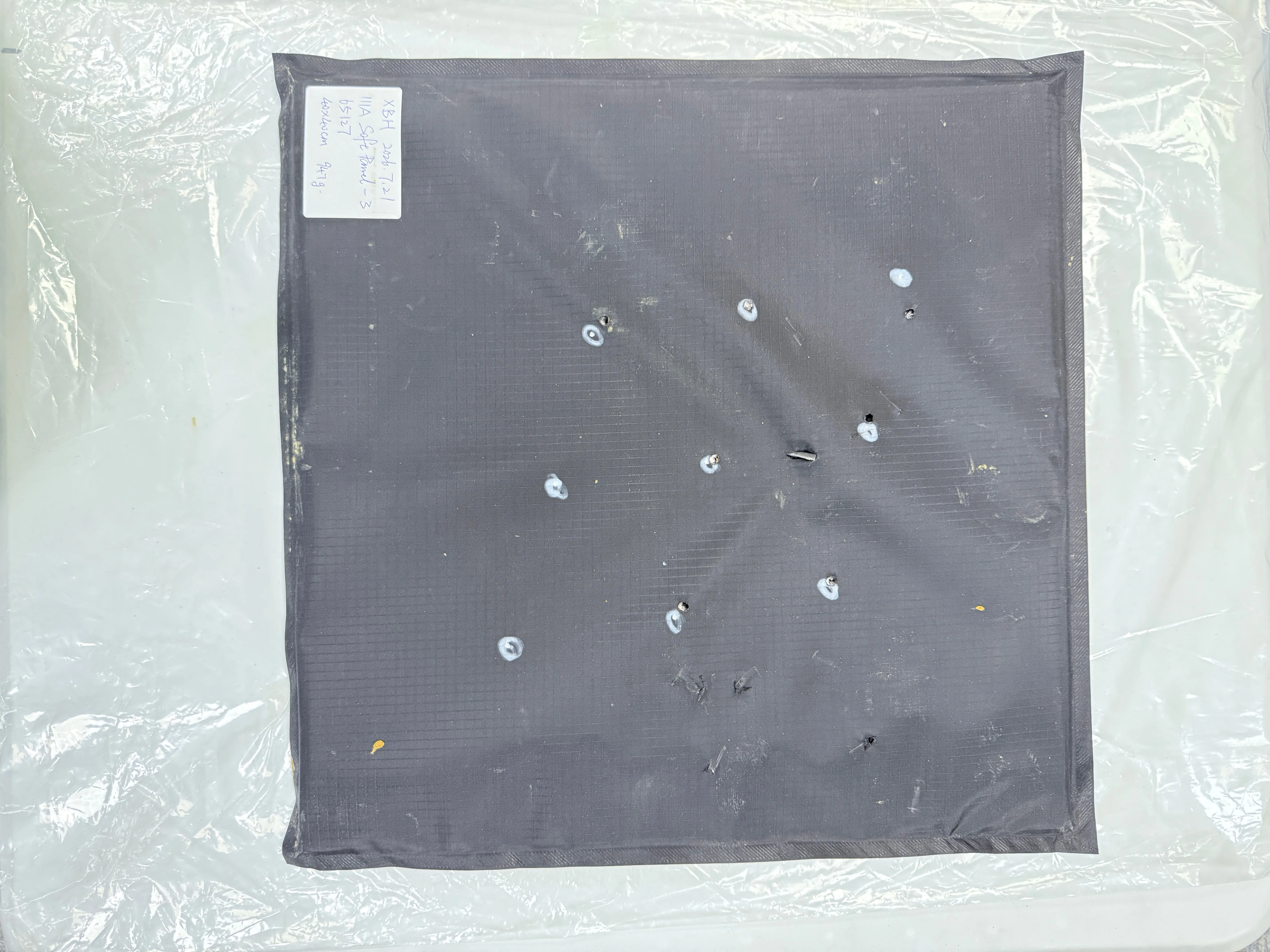
Below are the actual results from an independent ballistic laboratory test of an Ultra Safety soft ballistic panel used in our bomb blanket.
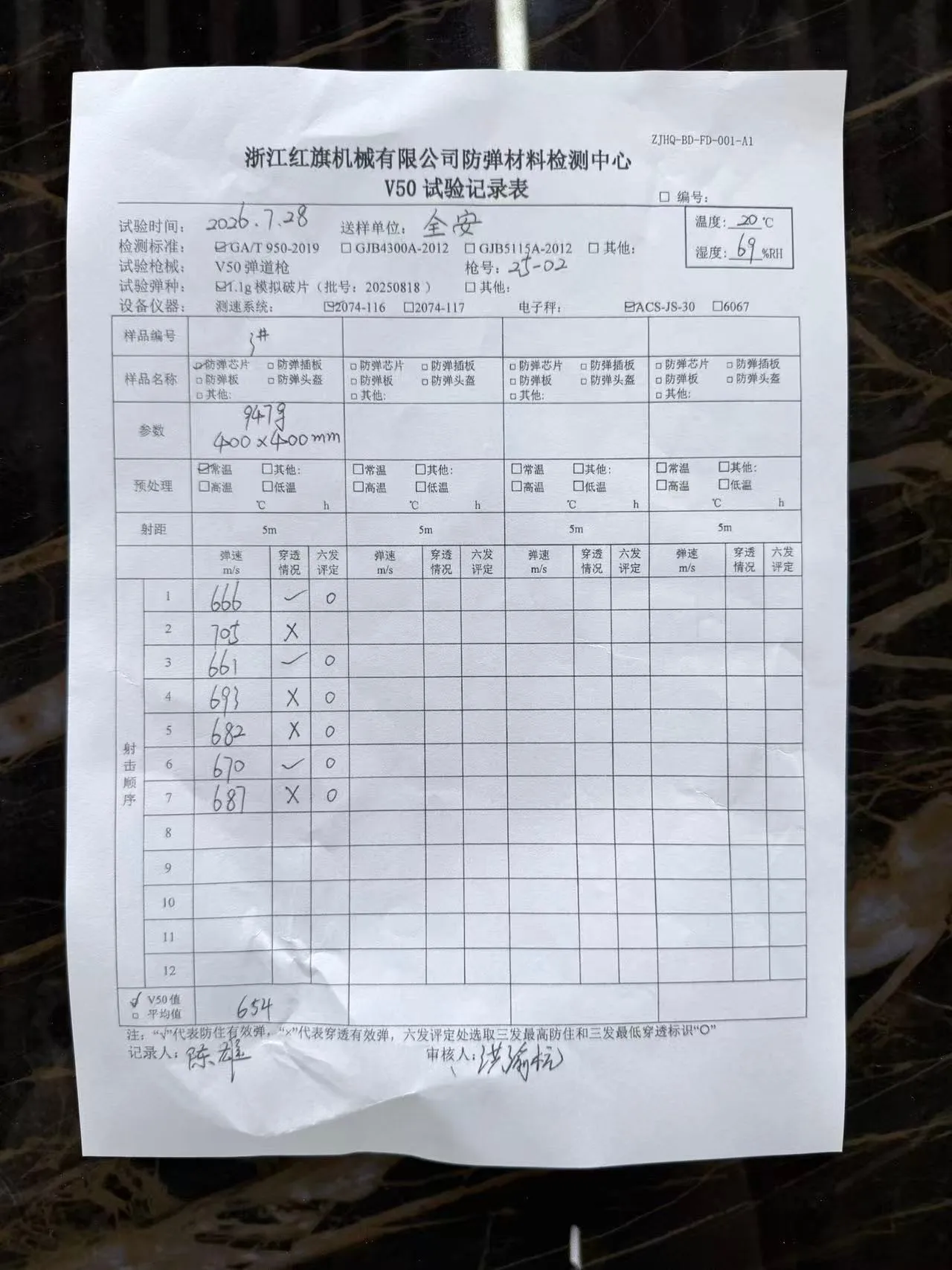
V50 test report

Test parameter | Value |
|---|---|
Testing standard | GA/T 950-2019 |
Projectile | 1.1 g FSP (fragment-simulating projectile) |
Test distance | 5 m |
Sample | Soft ballistic panel, 947 g, 400 × 400 mm |
Areal density | ≈ 5.9 kg/m² |
Conditioning | Ambient (20 °C, 69% RH) |
Measured V50 | 654 m/s |
Impact velocity record (m/s): 666 (stop) · 705 (perforation) · 661 (stop) · 693 (perforation) · 682 (stop) · 670 (stop) · 687 (perforation)
How to interpret this:
The panel stopped fragments up to 682 m/s and showed penetrations beginning around 687–705 m/s — a tight, consistent mix that produces a reliable V50 of 654 m/s.
At just 947 g for a 400 × 400 mm panel, the areal density of ~5.9 kg/m² is competitive for a soft, flexible system — meaning more coverage per kilogram for field teams who carry the blanket by hand.
The test was conducted by a third-party detection center, not in-house — the level of evidence procurement officers should insist on.
Buyer takeaway: When comparing two bomb blankets, normalize on the same standard and projectile mass, then compare V50 and areal density together. A high V50 at low weight is the real performance signal.
Different regions cite different fragment-protection standards. They are not directly interchangeable, so always state the standard in your RFQ.
Standard | Region | Projectile | Best used when |
|---|---|---|---|
GA/T 950-2019 | China (public security) | 1.1 g FSP | Sourcing from Chinese manufacturers; fragment protection |
NIJ 0101.06 / 0115 | USA | Handgun/rifle rounds; stab | Comparing against US body-armor levels |
STANAG 2920 | NATO | FSP (various masses) | Military fragmentation contracts |
VPAM | Germany / EU | Multiple threat classes | European government tenders |
For fragment-focused bomb blankets, an FSP-based standard (GA/T 950-2019 or STANAG 2920) is the most relevant — because in a real blast, fragmentation is the dominant threat.
Before you issue a purchase order, require the supplier to confirm:
Third-party V50 report — standard, projectile mass, distance, and V50 value clearly stated.
Areal density (kg/m²) — so you can compare weight-to-protection across vendors.
Panel + cover construction — aramid/UHMWPE layup, waterproof outer shell, reinforced stitching.
Handles & deployment — number and placement of carry loops for one- or two-person rapid deployment.
Size options — coverage area vs. portability trade-off for your mission.
Blast + fragment rating — confirm whether the blanket is rated for suppression as well as fragment containment.
Sample & re-test rights — ability to independently verify claimed V50 before bulk orders.
Ultra Safety supplies bomb blankets with documented V50 test data and OEM/ODM options for law-enforcement, military, and security buyers. Contact us for the full test report and a sample request.
There is no single universal figure — it depends on the threat and standard. What matters is that the V50 is independently tested and disclosed with the projectile mass and standard. The Ultra Safety panel above reaches 654 m/s against a 1.1 g FSP under GA/T 950-2019, which is a strong result for a soft, lightweight panel.
No. V50 measures protection against fragments (FSPs), which are the main threat in an explosion. Bullet protection is rated separately (e.g., NIJ levels). A quality bomb blanket should disclose both if it claims dual capability.
Because field teams carry the blanket. A blanket with a high V50 and low areal density (like ~5.9 kg/m² here) gives more protective coverage for less weight — critical for rapid EOD deployment.
Yes. Serious suppliers provide the full lab report on request. Always verify that the report names an independent testing center, the standard, the projectile, and the measured V50 — not just a marketing claim.
A ballistic shield is a rigid, handheld barrier mainly for direct-fire protection. A bomb blanket is flexible, designed to drape over and contain fragments from an explosive device — a different mission profile.
For anti-terror and EOD procurement, the V50 value on an independent test report is the most objective way to compare bomb blankets. Ultra Safety's soft ballistic panel delivers a documented V50 of 654 m/s (GA/T 950-2019, 1.1 g FSP) at just 947 g per 400 × 400 mm panel — proven fragment protection at a competitive weight, backed by a third-party lab.
Request the full V50 test report or a product sample at ultra-safety.com.


