
Views: 469 Author: Site Editor Publish Time: 2026-08-04 Origin: Site


The difference between casual visual concealment for a weekend hunt and multispectral evasion during a tactical deployment is profound. A single oversight in material choice can expose your position instantly. It can also ruin a highly planned operation. Today, the market overflows with cheap decorative netting falsely marketed as professional-grade gear. This widespread deception leads to premature tearing, rapid UV degradation, and critical concealment failures in the field.
You need an objective, spec-driven framework to evaluate and source the right gear. Relying on marketing fluff is dangerous. You must base your choices on operational realities. This guide walks you through evaluating structural needs, selecting proper sizing, and sourcing durable materials. You will learn exactly how to align your specific environmental conditions with proven concealment technologies.
Application dictates specifications: Military operations require multispectral (IR/Radar) scattering and strict fire-retardant compliance; hunting applications prioritize lightweight portability and 3D visual disruption.
Material composition is non-negotiable: Mesh-backed ripstop nylon with UV and anti-rot treatments is mandatory for prolonged outdoor exposure.
Sizing requires margin: Always account for a 10-15% drape and structural contouring allowance when ordering a custom camo net or bulk rolls.
Supplier transparency matters: Reliable manufacturers provide verifiable denier ratings, compliance certifications, and clear warranty terms over exaggerated stealth claims.
Before buying any gear, you must clearly define your operational threat environment. Different scenarios require vastly different protective measures. A product designed to hide a hunter from a deer will fail completely against a drone.
Tactical environments demand absolute reliability. Operational requirements often extend beyond visual line of sight (BVLOS). Modern threats use near-infrared (NIR) sensors, thermal imaging, and radar. You need a Camouflage Net designed for multispectral scattering to defeat these advanced optics. They disrupt electronic signatures rather than just blending colors.
Structural needs in these scenarios are intense. Troops cover heavy vehicles, forward operating bases (FOBs), and sensitive equipment. They require heavy-duty mesh backing to support massive spans. MIL-SPEC compliance and rigorous fire-retardant (FR) treatments are mandatory. You cannot safely drape flammable synthetics over hot engine blocks or generators.
Field sports present a different set of challenges. Here, operational requirements focus on strict visual disruption. You aim to break up human silhouettes and equipment outlines. You must match the localized flora and fauna vision profiles. Animals often detect movement and solid shapes before they register color details.
Structural needs prioritize stealth and mobility. Hunters prefer lightweight, unbacked, or lightly backed 3D leaf-cut designs. These allow for rapid deployment in mobile hides. Low noise generation is critical. You need stealth acoustics so the fabric does not rustle in the wind. High portability ensures you can pack it down into a small daypack.
You must assess your primary threat before making a purchase. Is the threat optical, like a wildlife or human eye? Or is it technological, relying on drones and thermal optics? Answering this question establishes your baseline budget. It also dictates your core material parameters. Choosing multispectral netting for a simple turkey hunt wastes money. Conversely, relying on standard leaf netting against thermal drones invites disaster.
Material science dictates field performance. If you ignore fabric specifications, your setup will fail when exposed to harsh weather. We must examine denier ratings, backing structures, and chemical treatments.
Manufacturers usually build netting from Oxford polyester or nylon. They measure the fabric thickness using denier (D) ratings. Common variants include 150D, 210D, and 300D. You face a direct tradeoff here. Higher denier yields better tear resistance. However, it also increases the overall weight and moisture retention.
A 150D fabric works well for personal use. It stays light and packs easily. A 210D fabric offers a strong middle ground for seasonal blinds. For permanent installations or heavy equipment, 300D is necessary. It withstands heavy wind sheer and abrasion.
Fabric Specification Comparison Chart
Denier Rating | Primary Use Case | Weight Profile | Durability Expectation |
|---|---|---|---|
150D | Personal hides, light hunting | Ultra-light | Low to Medium (Prone to snag tearing) |
210D | Seasonal blinds, small vehicles | Moderate | Medium (Good balance of strength and weight) |
300D+ | Tactical FOBs, heavy machinery | Heavy | High (Resists severe wind and abrasion) |
Structural integrity often relies on an underlying rope grid. A mesh-backed net features a woven structural framework sewn directly into the fabric. This reinforcement is essential for spans larger than 10x10 feet. It provides structural integrity and prevents wind-shearing. If you pull tightly on an unbacked net, the fabric will eventually rip.
Unbacked nets lack this rope grid. They are highly suitable for personal blinds or temporary tactical hides. You can drape them directly over low-profile gear. They remain highly flexible and easy to stuff into tight spaces. However, they cannot bear structural tension.
Untreated synthetic fabrics degrade rapidly outdoors. You must verify specific chemical treatments before finalizing any purchase.
UV Resistance: Prolonged sunlight causes fading and material brittleness. All nets eventually degrade under intense sun. However, professional UV treatment extends the lifespan from a few months to several years.
Rot and Mold Resistance: Swamps and humid forests destroy untreated fabrics. Anti-rot treatments are critical for nets left in damp environments. They prevent fungal breakdown.
Fire Retardancy: This is a hard requirement for vehicle coverage. You must demand it for areas near generators or campfires. Look for specific certifications, such as NFPA 701 compliance. Vague "fire safe" marketing claims offer no real protection.
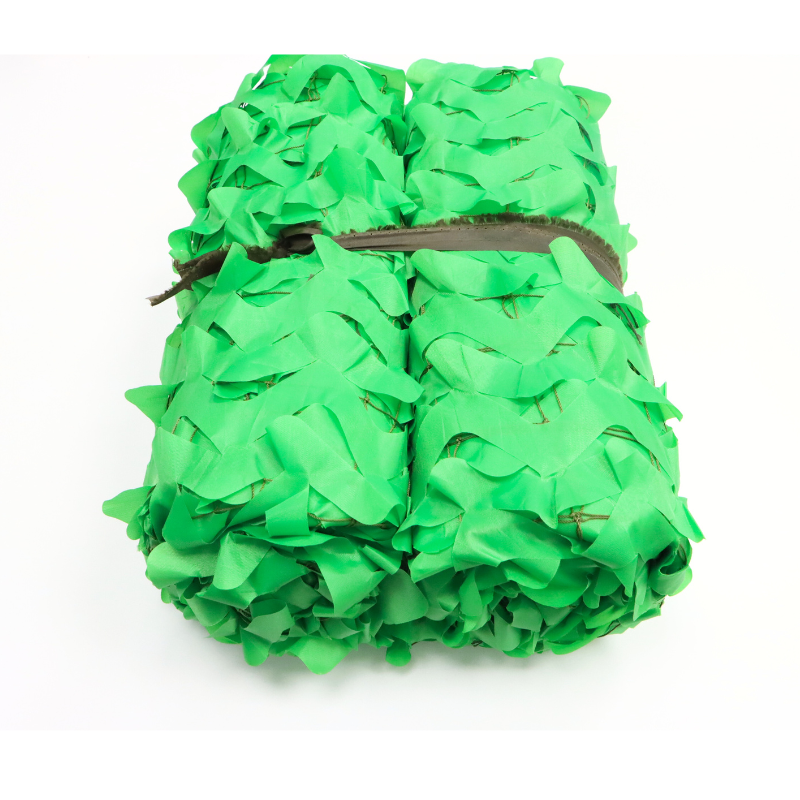
Color alone does not create effective concealment. The physical shape of the material plays a massive role in fooling the eye. You need the right combination of biome matching and shadow casting.
You must match your pattern to the specific operational zone. Contrast the deep greens of Woodland patterns against the muted tans of Desert layouts. Snow patterns utilize pure white with subtle grey disruptions. Urban digital patterns blend into concrete and structural shadows.
A practical implementation tip involves using reversible designs. Many premium nets feature green on one side and brown on the other. This provides excellent seasonal versatility for fixed positions. You simply flip the net when autumn arrives.
Manufacturers cut the fabric to create texture. The two most common styles are the "S-cut" and the "U-cut". Modern 3D leaf designs represent an evolution of these basic cuts. The cut dictates the material's ability to cast micro-shadows.
Micro-shadows represent the actual mechanism that fools depth perception. A flat printed sheet looks like a wall. A 3D cut flutters and creates distinct layers of light and dark. This disruption breaks up solid geometric shapes beneath the net.
You must prioritize matte finishes. A highly reflective surface will fail immediately under direct sunlight. It will shine brilliantly, completely negating any pattern accuracy. Animals and optical sensors catch glare easily. Always verify that the material undergoes a specialized anti-glare treatment during manufacturing.
Buying the right material means nothing if you order the wrong size. Improper deployment ruins the illusion of natural cover. You must calculate dimensions carefully and understand how to rig the setup.
Never order exactly the square footage of the object you want to hide. A flat, tight fit creates an unnatural geometric box. You must leave room for structural contouring. Use this formula for covering 3D objects:
Measure the length of the object.
Add the required drop (height) for both the front and back.
Measure the width of the object.
Add the required drop for both the left and right sides.
Multiply the total length by the total width to get your baseline square footage.
Add a 10% to 15% margin to the final dimensions for natural draping.
We must warn you against "tight fitting". Tension stretches the fabric flat. This ruins the 3D concealment effect. It clearly outlines the vehicle or equipment underneath.
You can buy pre-cut sizes or continuous rolls. Knowing when to choose each method saves time and budget. Pre-cut sizes work best for individual blinds or single vehicles. They come finished and ready to deploy.
You should buy by the roll when outfitting a large camp. Bulk rolls are also ideal for B2B wholesale needs or extensive custom installations. When you need a Custom Camo Net for a massive structural span, cutting from a bulk roll guarantees seamless coverage.
Field deployment introduces several practical risks. You must actively manage snag hazards. Vehicle antennas, side mirrors, and jagged tree branches quickly tear loose fabric. Always pad sharp corners before draping.
Joining multiple pieces requires care. You should use edge binding and reinforced grommets. Thread heavy-duty paracord or thick zip ties through the structural mesh backing. Never tie directly to the unbacked fabric. This modular joining technique allows you to scale up coverage without compromising structural integrity.
The market features hundreds of suppliers. Many sell inferior patio shade cloths under tactical labels. You need a strict evaluation framework to filter out bad actors. Knowing what to look for guarantees you secure legitimate Military Netting or reliable field gear.
Walk away immediately if a supplier refuses to state the denier thickness or base material. Vague descriptions like "heavy duty nylon" mean nothing without a number. Reject any claims of "thermal blocking" unless they provide verifiable multispectral testing data. Genuine IR-defeating nets undergo rigorous lab testing.
Another major red flag is the absence of reinforced edge binding on large sizes. If a 20x20 foot net has raw, unstitched edges, it will unravel rapidly in the wind.
Look for clear, written warranty terms regarding UV degradation. Reliable manufacturers stand behind their chemical treatments. They readily offer bulk or wholesale pricing structures. They easily accommodate custom sizing requests for unique installations.
Most importantly, seek transparent compliance. Quality suppliers readily list their adherence to international or local safety standards. They will gladly show you their NFPA fire testing results or military-equivalent certifications.
Do not simply add the first promising item to your cart. First, draft a rigorous specification sheet. List your exact required dimensions, factoring in the 15% drape margin. Specify your biome's environmental pattern. Note whether you require structural mesh backing or unbacked fabric. Only then should you request supplier quotes or speak to a sales representative.
Successful concealment relies on a deliberate combination of factors. You need accurate environmental matching, appropriate structural integrity, and proper deployment techniques. A failure in any of these areas compromises your position. Whether you seek a simple Hunting Camouflage Net or a complex tactical barrier, facts must drive your decision.
Prioritize structural mesh for any application larger than a single-person hide.
Demand verifiable chemical treatments, specifically UV and rot resistance, for long-term outdoor deployment.
Never stretch the material tight; always calculate a 10% to 15% margin for natural draping and micro-shadow generation.
Verify fire retardancy certifications if deploying near vehicles or heat sources.
Review your operational environment carefully. Draft your specification sheet today. Then, browse dedicated product categories tailored to military use, hunting setups, or custom bulk rolls. Contact professional sales support to align your dimensional requirements with the right industrial materials.
A: Lifespan depends heavily on direct UV exposure, wind tension, and base material thickness. A properly UV-treated net typically lasts 1 to 3 years continuously outdoors. If you deploy it seasonally and store it correctly in a dry, dark place, it can last indefinitely.
A: No. Standard hunting nets provide visual concealment only. They break up visible outlines but allow body heat to pass through. You must procure multispectral or specifically treated thermal military nets to successfully defeat IR and thermal optics.
A: You connect them using heavy-duty UV-resistant zip ties or strong paracord. Always thread these connectors through the reinforced edge webbing or the structural rope mesh backing. Never tie directly through the leaf fabric, as wind tension will quickly tear it.
A: The synthetic base material, like Oxford polyester, resists water and will not rot. However, the net itself is porous by design. It features countless cuts to allow wind and light passage. Therefore, it will not serve as a waterproof rain canopy.


