
Views: 240 Author: Site Editor Publish Time: 2026-08-10 Origin: Site


Procuring concealment gear carries massive operational stakes. Setting up a hunting blind, outfitting a security perimeter, or hiding high-value assets demands serious attention to detail. Choosing the wrong netting immediately compromises your operational security. It also invites rapid material degradation under harsh weather conditions. Buyers frequently struggle because the market overflows with wildly varying grades of netting. You might see cheap decorative meshes hanging right next to advanced multi-spectral defense fabrics. As a result, teams often overpay for unnecessary specifications or completely under-equip for brutal field realities. This guide clears up the confusion permanently. We provide a highly technical, application-based framework to evaluate and compare different netting options on the market. You will learn exactly how to select the right camouflage net for specific environmental conditions and demanding tactical scenarios.
Application Drives Specification: Hunting and commercial applications prioritize visual blending (e.g., Woodland Camouflage Net), while military and security operations require multi-spectral concealment (anti-IR, anti-radar).
Material Trumps Pattern: A pattern is useless if the material lacks UV treatment, rot resistance, or necessary fire-retardant certifications (e.g., NFPA 701) for your operating environment.
Mesh vs. Meshless Construction: Structural backing dictates durability. Mesh-backed nets withstand high winds and heavy handling, whereas meshless options are lighter but prone to snagging and tearing.
Modularity Matters: Enterprise and field deployments require modular netting that can be seamlessly cabled together without compromising the structural integrity or visual continuity of the hide.
Visual concealment goes far beyond basic color matching. To effectively deceive the human eye, you must fundamentally disrupt recognizable silhouettes and artificial shapes. Modern 3D leaf-cut designs excel at this task. They create artificial shadows and mimic natural foliage movement when the wind blows. By understanding these visual principles, you can better select the appropriate pattern for your specific environment.
Forested areas and temperate zones require carefully calibrated color profiles. A Woodland Camouflage Net features high-contrast browns, rich greens, and deep blacks. It effectively breaks up hard lines in environments covered by heavy canopies. We often see hunters, wildlife photographers, and tactical teams deploy these nets across mixed foliage, deciduous forests, and dense brush. The varied color palette ensures your equipment does not stand out against tree trunks or leafy backdrops.
Sand, rock, and sparse vegetation environments demand an entirely different approach. Desert patterns utilize dominant tan, coyote, and light brown hues. Manufacturers typically engineer these nets for significantly higher UV resistance. Increased sun exposure in arid zones rapidly degrades lesser materials, making robust UV protection a mandatory feature. They blend perfectly into dunes, rocky outcrops, and dried grassland.
Tundra regions and heavy snowfall areas present unique environmental challenges. Pure white or white-and-grey pine mixes dominate this specialized category. However, color alone is never enough for winter operations. Manufacturers must chemically treat the fabric to resist freezing. Without this crucial treatment, the netting rapidly stiffens and cracks in sub-zero temperatures, rendering it completely useless for mobile operations.
Modern urban settings require highly specialized patterns. We rely heavily on grays, blacks, and block-pixelated designs here. They blend seamlessly against concrete, asphalt, steel structures, and deep building shadows. Security surveillance teams, tactical law enforcement units, and industrial concealment operations frequently utilize these digital variations to mask command posts and observation blinds in metropolitan environments.
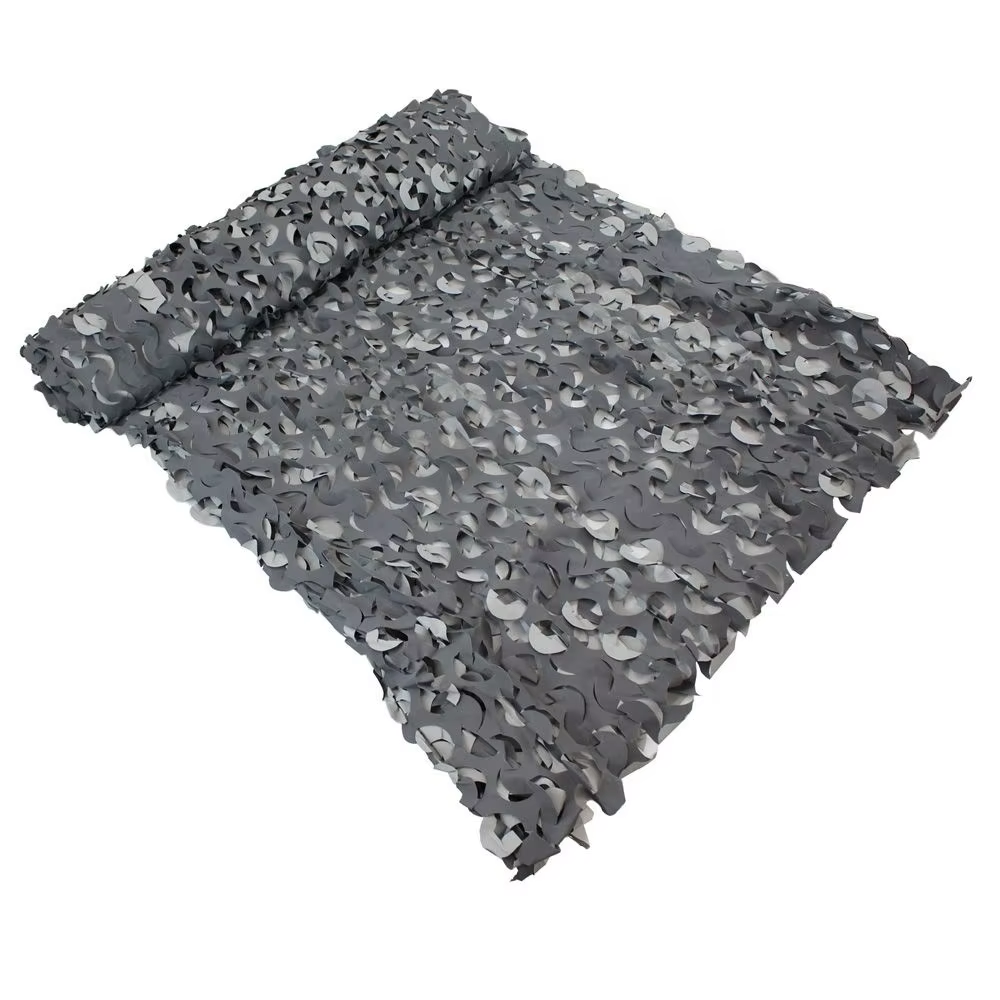
You must understand the technical baseline before making a purchase. Commercial and hunting nets usually focus purely on the visual spectrum. They simply hide you from the naked eye. In contrast, professional defense-grade solutions operate across multiple spectrums and withstand extreme environmental abuse.
Modern field operations rely heavily on thermal imaging and radar technologies. A genuine Military Camo Net must actively defeat Near-Infrared (NIR) detection. These advanced fabrics mask heat signatures against night vision equipment and thermal optics. Furthermore, specialized defense contracts often require Radar Cross Section (RCS) reduction. Engineers weave special scattering fibers directly into the fabric to disrupt radar waves, protecting high-value assets from long-range detection.
Prolonged outdoor exposure ruins untreated fabrics quickly. Without a heavy UV coating, commercial nets bleach out and become highly brittle within three to six months. Professional deployments require guaranteed long-term durability. Polyurethane (PU) coatings provide essential rot and mildew resistance. This chemical treatment remains critical for extended deployments in humid jungles or damp woodland environments.
Synthetic materials pose massive fire risks in the field. Operating near heat sources, diesel generators, or munitions demands certified safety measures. You cannot risk using highly flammable netting in these volatile environments. Certified fire-retardant treatments are entirely non-negotiable for indoor setups, perimeter security, and large public events. Look for verifiable standards like NFPA 701 compliance.
Technical Feature | Commercial Grade | Defense / Military Grade |
|---|---|---|
Spectrum Concealment | Visual spectrum only (Naked eye) | Multi-spectral (Visual, NIR, Thermal, RCS) |
UV Degradation Resistance | Low to Moderate (3-6 months continuous) | High (3-5+ years continuous exposure) |
Fire Retardancy | Rarely treated, highly flammable | Strictly certified (e.g., NFPA 701) |
Rot & Mildew Resistance | Basic water resistance | Advanced Polyurethane (PU) coated |
The physical construction of your netting dictates its overall durability and handling characteristics. You must choose between bulk fabric and reinforced grids based on your specific mission parameters and logistical constraints.
Meshless netting consists solely of die-cut 3D fabric without any underlying support structure.
Pros: This design is incredibly lightweight. It compresses easily into small tactical packs, making it exceptionally simple to transport. Mobile infantry units, solo hunters, and fast-moving teams appreciate the low bulk.
Cons: The distinct lack of a structural grid severely limits overall tensile strength. The fabric tears easily if snagged on rough branches or sharp equipment corners. It also performs poorly in high-wind conditions, often stretching or ripping under sustained pressure.
Mesh-backed nets feature a rigid structural grid bonded directly to the camouflage fabric. Manufacturers usually construct this grid from heavy-duty paracord or thick nylon rope.
Pros: The rope grid prevents localized fabric tears from spreading across the entire net. It also allows you to span much larger gaps between trees or vehicles without severe sagging. You can pull the net tight to create a flat, secure canopy.
Cons: These nets are significantly heavier and bulkier to store in limited spaces. They also carry a slightly higher initial purchase price. However, they remain absolutely essential for permanent or semi-permanent installations where durability is paramount.
Field deployment rarely goes exactly as planned in the training manual. Environmental factors and rough terrain quickly test the true quality of your concealment gear.
The 3D leaf-cuts look highly realistic from a distance. Yet, these complex cuts easily catch on vehicle antennas, protruding weapon systems, and rough terrain. Operators must handle the netting carefully during rapid deployment phases to prevent damaging essential equipment or tearing the fabric outright.
Proper tensioning determines your deployment success. Improperly secured large nets capture wind and act as massive sails. This immense force can severely damage your concealed equipment or violently rip the fabric apart. You must anchor the structural grid securely to fixed points.
Real-world hides rarely fit standard factory dimensions. Purchasing modular netting serves as a critical operational strategy. Look for nets equipped with heavy edge binding and strong tie-off loops. Grommets or extended paracord grids allow you to join multiple pieces smoothly. A premium Tactical Camouflage Net connects seamlessly using heavy-duty zip ties or climbing carabiners to cover massive logistical footprints.
The dreaded "rustle factor" ruins close-proximity concealment. Cheaper plastic meshes turn rigid and incredibly noisy in cold weather. Every gust of wind broadcasts your exact location to anyone nearby. Premium tactical materials utilize specialized polymers. They remain highly pliable and dead silent, even when temperatures plummet well below freezing.
Follow these essential steps for a secure field deployment:
Survey the surrounding terrain to identify strong, natural anchor points.
Unfold the netting slowly to avoid tangling the internal mesh backing.
Secure the windward edge first to actively prevent the dangerous sail effect.
Apply even tension across the structural rope grid, rather than pulling directly on the fabric.
Navigating the complex procurement process requires a clear, objective framework. You must precisely align your actual threat matrix with material realities to avoid costly mistakes.
Define the Threat Matrix: Identify exactly what you are hiding from. Hunters and civilian enthusiasts primarily need to evade the naked eye. Security teams and tactical operators must counter thermal drones, aerial surveillance, and night vision devices. Asset protection managers focus heavily on defeating long-term weather degradation and UV damage.
Calculate the Lifespan ROI: Avoid the dangerous trap of cheap, constant replacements. A basic commercial net might bleach, tear, and fail three times a year in harsh sunlight. In stark contrast, a professional UV-treated, mesh-backed net often lasts five solid years in the exact same conditions. High-quality materials save critical resources, reduce labor, and maintain continuous operational security.
Verify Compliance Requirements: Never rely on vague marketing claims or unverified seller descriptions. Enterprise, military, or indoor security applications demand strict adherence to documented safety standards. Demand official spec sheets proving fire retardancy, precise tensile strength, and multi-spectral capabilities before approving any large-scale purchase order.
Camouflage netting is far from a simple, one-size-fits-all commodity. It remains a highly specialized piece of critical concealment hardware. Understanding the underlying materials, structural designs, and environmental coatings prevents dangerous procurement mistakes.
Always choose your base pattern based on your specific operational theater. However, you must make your final purchasing decision based on rigid material specifications. Prioritize a strong structural mesh backing, robust UV treatments, and verifiable multi-spectral IR resistance for serious deployments.
Stop guessing with your operational security. Review a professional product catalog to explore advanced material options. Request a detailed B2B quote for custom sizing, or speak with an industry expert to source the exact Camouflage Net required for your demanding multi-spectral mission.
A: Woodland refers strictly to the visual color and printed pattern. It mimics forest environments to fool the naked eye. Tactical or military nets refer to the material's advanced capabilities. They actively defeat thermal and IR optics while withstanding extreme field abuse, high winds, and harsh weather.
A: Basic untreated commercial nets generally bleach and become brittle within 3 to 6 months of continuous use. High-quality professional nets, utilizing robust UV treatments and heavy polyurethane coatings, easily last 3 to 5 years under continuous outdoor exposure.
A: You can easily cut meshless nets without unravelling the core fabric. However, modifying mesh-backed nets requires extreme caution. You must re-secure the structural rope grid tightly after cutting. Failing to do so destroys the entire net's tensile strength and structural integrity.
A: Most feature water-resistant coatings so they do not absorb heavy moisture. Absorbing water adds massive weight and causes severe rot over time. However, due to their porous 3D leaf-cut design, they do not function as waterproof tarps or solid rain shelters.


